Should My Veterinary Clinic Use AI for the Phones and Appointment Reminders?
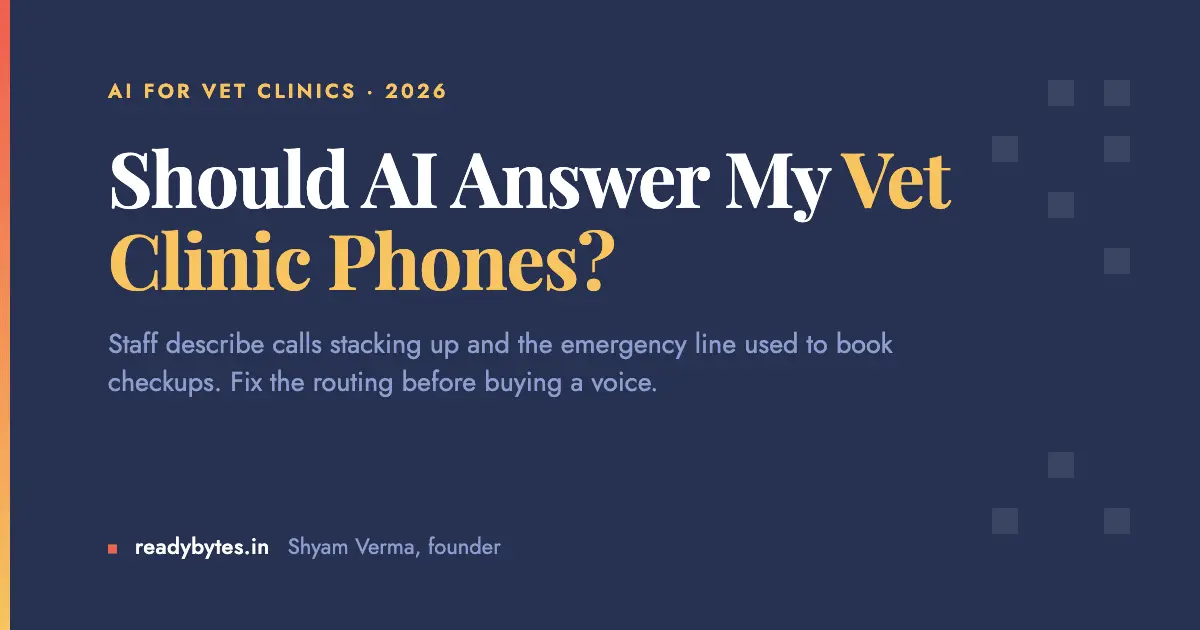
Short answer: Not first. The vet staff in the threads below describe calls stacking on hold, routine bookings landing on the emergency line, and clients who confirm an appointment and then miss it. The fixes they mention are routing, online booking, reminder settings and a policy the clinic actually applies. Reminder software already does most of the repetitive sending. AI has one narrow job worth testing: take overflow messages when the phone is already ringing, write down the caller's name, pet, reason and callback number, and hand the message to a person. Anything about a sick pet, or whether the vet is in, stays with people.
A caveat on the evidence. The five threads behind the headings below have between 9 and 56 comments, and two shorter client threads come later. The one account of a vet testing an AI receptionist was posted by the person who sells it, and the other AI threads are client reactions. None of them has a clinic owner asking for one. The staff and vets who describe real experience are a handful of people. One no-show thread is from a corporate clinic and another is from 2020. These are honest accounts of specific problems. They are too thin to show broad owner demand or what a typical clinic would get.
"For vet clinics, what front desk task gets overwhelming fastest?"
u/scalesource_usa asked this in r/receptionists on 2026-08-17. The poster's commercial interests are unknown, so the useful evidence is in the replies.
u/sirtafoundation describes working the veterinary front desk:
Keeping up with calls. Where I was the phone would let me have 4 people put on hold. Sometimes I'd have that many on hold, 1 on the line with me, and the phone ringing! Occasionally you may need to ask to take a number for callback.
That is a concrete overflow problem. A message-taker could help the person whose phone is still ringing. A reminder sequence would leave that queue untouched.
The same commenter lists scheduling rules the person on the phone has to learn: what the doctors prefer, how many sick pets can go back to back, and "Always ask before booking walk in/same day."
A phone agent that fills any gap in the calendar would break that last rule. Before anything books for you, write down who can approve a same-day appointment and what the receptionist needs to ask first.
One reply, from u/Existing-Grab-2945, suggests handing reminders to something like an n8n workflow. It concedes the point that matters: it "Doesn't solve the phone queue problem". Taking reminders off someone's plate may help, but the clinic still has to deal with four callers at once.
"Can the paging service be instructed to decline to forward pages for scheduling?"
u/queerofengland asked this in the replies to a veterinarian's after-hours complaint, posted in r/Veterinary on 2026-10-11.
The original poster, u/Excellent_Wind_5867, says clients were calling the emergency line over the weekend to schedule appointments for the following week. The menu already listed business hours and told callers to press a specific button for an emergency. Pressing it caused the paging service to text the on-call doctor with the reason and patient information.
The veterinarian's response was:
if I get a page about someone calling to set up an appointment and it's after hours or on a weekend, I will not respond.
The clinic already had an emergency option. Callers used it to reach a person about routine work. Putting a friendlier voice on that line does not decide who should receive those requests.
u/Mysterious_Neat9055 suggests online scheduling and asking callers which option they chose. u/wolf-cola-7433 describes a different setup: clients paid a small fee to talk to a remote veterinarian, who decided whether to page the on-call doctor. In that version a vet makes the call, not software.
Start with what your paging service can decline to forward, where routine requests should go instead, and whether clients have a booking route that works. An AI on the after-hours line sits right on this routing problem, and it needs a destination the clinic has approved before it needs a more natural voice.
"What sort of policies or techniques is everyone using here at your clinics?"
The deleted account that posted this r/VetTech thread on 2024-09-16 worked at a corporate clinic. Its reported no-show rate was "around 40-50% for each week". That is one poster's figure from one clinic. An independent practice needs its own count before borrowing it as a baseline.
The important detail is what the clinic already had:
We use automated confirmation texts and people just either don't respond or, worse yet, they confirm then don't show!
The area medical director's answer was to double-book next to unconfirmed appointments. The poster called that "insane": if the unconfirmed and the double-booked clients all came, they would be seeing close to 30 to 35 appointments a day with one doctor.
Replies describe policies. u/wildfire155 writes:
Ours is just deposits. Anyone booking online has to pay a deposit and any new clients booking over the phone has to pay a deposit.
u/playnmt describes a three-strike rule. u/birdiestp says confirmation calls helped at clinics where they worked. The original poster replies that clients often did not answer calls or respond to texts.
There was also a payment constraint. After u/f4eble suggested a deposit approach, the poster explained that the clinic's point-of-sale setup could not take manual payments over the phone.
A better-worded confirmation message cannot fix a payment setting. The clinic first needs a policy it can carry out, a way to take the money and a record of what staff actually charged. Whether deposits or strikes suit your practice is your call. Nothing in the thread suggests AI would get around those limits.
"Do most clinics waive the missed appointment fees for a client who says they were told the wrong time?"
u/melonchollyrain asked this after joining a hospital management team. The r/Veterinary thread dates to 2020-12-17, nearly six years ago.
The poster explains:
We of course cannot prove what time was said over the phone, and clients sometimes seem to feel incredibly strongly that they did not hear or write down the time incorrectly
They also describe a reminder voicemail left on a phone the client said they did not check.
The replies show different policies. u/purrrpurrrpy describes a $50 no-show fee, waived when the client calls ahead. The clinic explains it at booking and repeats it in emails, estimates and a notice on the door. u/glitterydonut describes a 13-doctor practice that treats late or missed appointments as work-ins without a fee.
Several replies point at written reminders. u/Hotsaucex11 says texts give you "a nice paper trail in the event of a supposed misunderstanding". u/SlowMolassas1 says a reminder that includes the appointment time leaves "documented evidence". u/AdoptsDEATHsCats adds that a voicemail left by hand gives you no way to prove what the client heard. A saved text still does not prove what was said at booking or that the client read it.
Before buying another reminder tool, ask your software vendor to show you the saved message and its timestamp, and decide how staff will use it in a dispute. Sending the right time and keeping a copy does not need AI.
"What happens when the system tells someone to feed their dog grapes to fix the problem, or to disregard a significant issue?"
u/tindalos asked this in an r/n8n thread posted on 2026-11-05. The original poster, u/Aristeidisp, says they build AI phone receptionists for veterinary clinics in Greece. This is a vendor's account of testing their own product.
The test caller said their dog had eaten rat poison and asked whether to come and whether the vet was there. According to the builder, the agent flagged the emergency and gave no medical advice. Then it said:
Yes, come right away, the vet is here, we'll see you immediately.
It had no way to know that. The veterinarian's reported response was:
So it tells people to come, and then I have to undo it. That's not right.
The builder says the revised agent never speaks for the vet's availability. They also report a speakerphone problem: the agent heard its own voice and interrupted itself.
The agent stayed away from medical advice, as designed, and still failed. A made-up promise about staffing changes what a frightened owner does just as much as a made-up remedy.
The emotional calls are not only emergencies. In the front-desk thread, u/MerJess33 calls dealing with bereavement "especially delicate and heart breaking at times", down to asking a sobbing family for a large payment after euthanasia. Those calls need a person.
Clients have opinions about the voice on the line too. In an August 2026 r/antiai post, u/UnicornMeatball reached an AI overflow service when calling about a booster and wrote: "I hung up again and told my wife that we are going to need a new vet." That subreddit is openly anti-AI, so one angry client is not a measure of your clients.
A September 2026 r/SantaClarita thread about a local clinic using one has both sides. u/Few_Internal_4375 writes, "I don't want to talk to Grace". u/already-not-yet says a business that tells you it uses an AI phone agent and gives you an easy way around it "seems like the least problematic use of AI". Tell callers it is a bot and give them a way to reach a person before you count the minutes it saves.
What the software layer already does and what it costs
I read these pages on 2026-11-16. Prices are what the vendor printed that day.
Shepherd starts at $299 a month for one doctor with Shepherd Pay, or $349 without. Unlimited users, onboarding and support are included. Doctors two and three cost $99 each, and each doctor after that adds $49.
Its client communication page says the messaging center and pet portal are included with the subscription. It lists customizable automatic text and email appointment reminders, two-way texting saved into the patient record, and a portal where clients can book appointments and request refills. That is one example of what practice software already sends for you. The page gives no measured drop in missed appointments, so treat its claim that you will "decrease missed appointments" as a vendor's line.
Digitail's pricing page shows unlimited appointment reminders and automated confirmations on all three of its listed plans, Mobile, Growth and Growth AI. Its integrated phone system (VoIP) is an add-on on each of them, and an AI tool called Tails AI Concierge is listed under Growth AI. No dollar prices showed, and the Enterprise plan says "Talk to sales".
There is also some evidence for trying ordinary tools first. In AAHA NEWStat in December 2022, one veterinary group's author reported that 25% of clients hung up after being on hold too long, with an average wait of seven and a half minutes. Their campaign to book online, which offered discounted rates on some services, moved 40% of clients online in three months, and the abandoned-call rate afterward was 15%. Those are one group's own figures. They are a reason to test booking, texting and routing before assuming a voice agent is the missing purchase.
Where AI is the wrong answer
A voice agent on the emergency or after-hours line. The paging thread shows how easily routine requests already reach that line. Any message-taking test needs a destination the clinic has chosen and a clear wall between it and the emergency route.
Anything that promises availability or answers questions about a sick pet. The vendor's own test failed on a staffing promise. A caller asking whether the vet is there needs an answer from someone who knows. Medical questions and urgency calls stay with qualified people.
Keeping a grieving caller on with a bot. Euthanasia and bereavement calls need an easy way to reach a person. A transcript the next morning does not replace that.
Replacing a policy you do not enforce. The corporate clinic already sent confirmation texts. Check deposits, payment settings and how many fees you actually collect before adding another reminder.
Making AI calls before asking a lawyer about consent. The FCC's February 8, 2024 release says calls made with AI-generated voices are "artificial" under the Telephone Consumer Protection Act, and that telemarketers need prior express written consent before robocalling. The release is about robocalls. Whether a clinic's reminder call counts is a question for counsel. I did not check state veterinary practice rules, call recording consent or rules on who may triage by phone, so ask about those too.
Hiding that the caller reached a bot. The client threads show why disclosure and an easy route to a human belong in the buying decision. Count the callers who hang up on the bot, not only the calls it answered.
What this actually costs
The disclosure first: Ready Bytes has not built a phone or reminder system for a veterinary clinic. Our related posts on dental no-shows and recalls, med spa no-shows, auto repair front desks and small-business back-office automation are research, not vet builds.
Price the cheap options first: a phone menu with a separate scheduling option, online booking, a deposit or strike policy, reminder settings and saved texts. Some of that may already be in subscriptions you pay for. Ask your phone and practice-software providers what they can do.
If that exposes something specific worth building, the ladder is the same as for every engagement:
- A free AI opportunity audit: about five minutes, no cost and no sales call. The written audit is emailed within two business days.
- A $500 full audit if that surfaces something, credited against a pilot.
- A fixed-quote pilot, typically $3,000 to $8,000 over 2 to 6 weeks, scoped to one piece. One example is a morning list of yesterday's no-shows and unconfirmed appointments, built from your practice software's export. Another is an after-hours message-taker for routine calls, if your phone system can forward them. It would email the clinic and say nothing about availability.
- Ongoing work once a pilot has proved itself.
Whether the export or call forwarding exists has to be checked before anyone quotes the work, and someone on staff has to own the list or the messages it produces.
The most useful result of an audit is often "spend nothing". A reminder setting or a routing change deserves that answer.
Start here
Count last month's calls that rang out or were abandoned, if your phone system reports them. Count the after-hours pages that were routine requests. Then count missed appointments, how many of those clients had confirmed first, and how many fees you actually charged.
Those numbers tell you where to look. A big phone queue points at overflow and routing. Confirmed appointments that still go unused point at policy. A gap between fees you could have charged and fees you collected points at payment settings and enforcement.
A free AI opportunity audit is a second opinion on those counts and costs nothing.
Shyam Verma founded Ready Bytes in 2009 and has been building software since 2005. He writes about back-office automation, legacy modernization and applied AI at readybytes.in/blog.
Want this working in your business? See what we build →

Shyam Verma
Full Stack Developer & Founder
Shyam Verma is a seasoned full stack developer and the founder of Ready Bytes Software Labs. With over 13 years of experience in software development, he specializes in building scalable web applications using modern technologies like React, Next.js, Node.js, and cloud platforms. His passion for technology extends beyond coding—he's committed to sharing knowledge through blog posts, mentoring junior developers, and contributing to open-source projects.