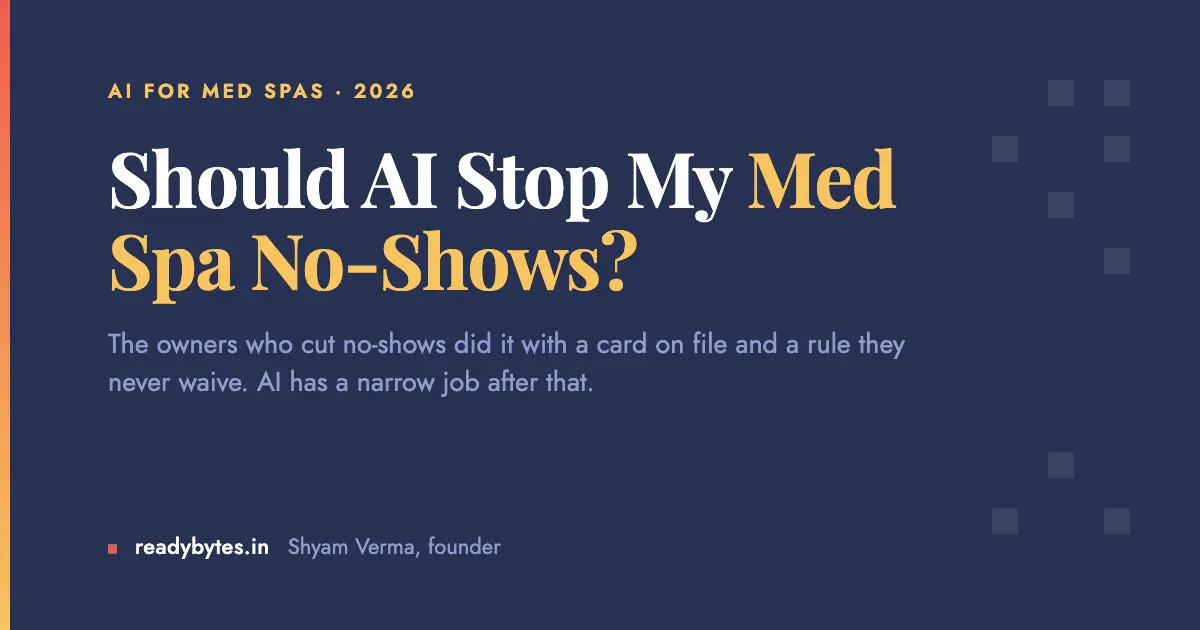
Short answer: Not first. The two med spa owners in the threads below who report real numbers got them from policy, not from AI. One charges $100 for a no-show or a cancellation inside 24 hours, requires a card on file from every new client, and says no-shows fell 90 percent. The other has had deposits and cancellation policies for about a year and went from a 14 percent no-show rate to 6 percent. The features that do that work (deposits, text reminders, a waitlist) are listed as included on every tier of at least one major med spa booking system, so most owners already pay for them. AI has a narrow job after that: a rebooking message to someone who missed, and refilling a slot that just opened. The recovery numbers quoted for it come from accounts that sell it, and none of them can be traced. If your policy is not enforced and your reminder timing has never been tested, no AI tool is the next purchase.
A caveat on the evidence. The med spa signal on Reddit lives in r/MedSpa and a few software subreddits, and it is thin: the threads below have between 9 and 73 comments. Some were started by accounts that sell something, and others are full of vendor replies. Where that applies this post says so and quotes only unaffiliated owners. The owners who give numbers are a handful of people, not a survey.
"I want to try a 1-hour reminder since most of our no-shows say they just forgot."
u/Mental-Fox7191 posted this to r/WhichCRM on 2026-08-07, 15 comments, and the numbers in it are the best in the research:
We've had no-show policies, cancellation policies, and required deposits in place for about a year. It has helped a lot. Our no-show rate is now 6% down from 14%.
Then the ask:
My only real 'must-have' is the ability to experiment with appointment reminders. Right now we send confirmation at booking and a 24-hour reminder. I want to try a 1-hour reminder since most of our no-shows say they just forgot.
Read what that owner is asking for. It is a reminder timing setting and a way to see whether it worked. That is a scheduling-software feature, and one of the replies, from u/kayla93blair, says the reason they moved to Boulevard was reporting that pulls no-show rate by time period, client type and service category, plus a test of different deposit amounts by service tier.
The same owner named the fear that matters for AI: "My biggest fear with using an AI tool for this is that it goes off the rails and does or says something undesirable that scares off clients." One reply pitched AI anyway. u/No_Bat_1143 wrote that they built a voice agent on ElevenLabs and Twilio that makes a reminder call and sets the next step from what the client says. The same reply admits it "requires the clients to consent to receive such calls, and apparently it's way more expensive to implement." Another recommended a reminder product, DearDoc, by name. Neither said what happens when the agent says something wrong to a paying client, and the owner did not ask for either to be built. Treat those two replies as vendor-adjacent.
"How much do you charge for no shows?"
The top comment in an r/MedSpa thread posted 2026-07-02, with 25 comments, is from u/Accurate-Code2912. It is the only owner in the threads read for this post who gives a fee, a trigger and a dispute process:
We implemented a no show policy 2 years ago. it reduced no shows 90%. when you make an appointment as a new client we need a card on file, if you don't show up or try to cancel less than 24 hours before your appointment its automatic charge.
Two days later u/Trappedinacar replied with the question above, and the answer was: "We charge $100, our calls are recorded and when someone tries to dispute the charge we just send the recording with the disclaimer about the no show policy and they lose." The recording is the useful detail. The fee works because the client was told the rule, on the record, before the visit.
u/Beneficial_Pause8053 runs the other version: a no-show and late-cancel policy signed every 6 months, repeated in every email, and never waived. "We haven't started charging deposits because we don't want to deter people, but consistency with our cancellation policy has cut down on the problem a lot." The same owner is honest about the ceiling: "I don't think the cancellation fees or deposits will ever actually make up for the wasted time, but at least it's a little buffer." And u/Background_Loss4382 collapses the debate between deposits and fees: the issue is someone who "doesn't want to secure the appointment with a credit card."
The owners with numbers describe a rule, applied the same way every time, not a tool. One reply does credit a named product, Anservo, with cutting no-shows "down a good bit", but it gives no figure and reads like the pitches below, so it is not counted here. The thread is also a clean example of what seeded Reddit looks like. One account pitched "an automated follow-up system for this exact problem" and offered a demo. Another disclosed "I make Remind1, an SMS reminder tool". A third posted a link to a website it built, twice. u/amnah2100 summed up the room: "Let me guess, you're selling aGeNtS". Everything quoted above is from the owners, not those accounts.
"Do you have a system for following up with them or do most of them just rebook on their own eventually?"
That is the question from a r/MedSpa thread posted 2026-07-03, 13 comments. The account that posted it is the same one that pitched its own follow-up system in the thread above, so the question itself is set aside as marketing research and only the replies are used.
u/HenryRms gives the most useful framework in the research, and it needs no software:
I'd separate no-shows from last minute cancellations because they usually need different follow-up.
And on triage: "A missed Botox touch-up and a missed first consult from a paid ad probably shouldn't be handled the same way."
u/Ill_Brother8533 writes that "deposits at booking are the single biggest lever" and that a "quick message asking if they want to rebook converts more than people expect, bc most forgot rather than intentionally ghosting." The same reply recommends two clinic systems by name, so weigh it accordingly.
Then there is this, from u/Maleficent_Error_944: an automated follow-up within 30 minutes of a no-show is "recovering 30 to 40% of no-shows that would have otherwise gone cold." No client list, no clinic name, no method, and it is written in the voice of a sales deck. That is a claim to ask a vendor to back with your own data, and this post does not repeat it as a result. If a tool is worth buying, a pilot on your own cancellation list will measure the recovery rate in a few weeks.
"We have HIPAA to worry about too since we're a med spa."
The owner from the first section wrote that, replying to the voice-agent builder. It is the right worry, and the research does not settle it.
HHS says the HIPAA Rules apply to covered entities and business associates. Health care providers are covered "only if they transmit any information in an electronic form in connection with a transaction for which HHS has adopted a standard," and "If an entity does not meet the definition of a covered entity or business associate, it does not have to comply with the HIPAA Rules." A covered entity that hands work to a vendor needs a written business associate contract with it. (HHS page, content last reviewed August 21, 2024.)
So whether your spa is covered depends on whether it bills anything electronically in a standard way, which differs by practice. In a thread started by an AI-booking vendor, one commenter said "you don't actually have to be if the medspa is all cashpay. Which almost all are." The reply was "That is 100% wrong." Neither gave a source. Do not use either as legal advice, including this post. Ask your own lawyer or compliance contact whether your practice is covered, and ask any vendor that will read your client list or message history whether it will sign a business associate agreement. GlossGenius, for one, includes HIPAA compliance on both of its med spa plans, and on its beauty plans only from the Gold tier up.
The same question applies to a voice agent. The FCC ruled on 2024-02-08 that calls made with AI-generated voices are "artificial" under the Telephone Consumer Protection Act, and its release says telemarketers need prior express written consent before robocalling. The release is about robocalls and telemarketing; whether an appointment reminder from a clinic needs the same consent is a question for counsel. The builder in the first thread already said clients must consent to such calls.
"What medspa software are you actually happy with?"
u/GusBell1987 asked this in r/MedSpa on 2026-01-20, and it drew 73 comments, the largest thread here. This is the question that decides whether you ever get to AI, because every AI tool has to read and write to a calendar.
u/eurogonian has been on Nextech five years: "I cannot in good conscience recommend it due to outrageous pricing and combative 'customer success managers'... The nickel-and-diming is endless." The OP says they left Zenoti, which they called "horrific". u/chris11049 has used Zenoti, Boulevard, AestheticsPro, Jane, Vagaro, Square and MangoMint, and warns about stitching tools together: "api connections can break and I used to spend more time fixing crap like those issues instead of working inside of one application." u/c32knight, who says they have done acquisitions for about 50 med spas, adds that the result is "also in how you utilize them."
That is the argument for staying inside the system you have. A bolt-on that talks to a calendar through an API is a thing that breaks, and the person who finds out is the front desk. A vendor post in another subreddit claims that Boulevard, Vagaro, Mangomint and Aesthetic Record lack open APIs; that post is the vendor's own and is not relied on here. Boulevard's pricing page mentions APIs only under its custom Enterprise plan ("the industry's most powerful APIs"), and its tier comparison does not say either way for the lower plans. Confirm with your vendor before anyone quotes you a build that depends on one.
What the tools actually cost
Every price below is what the vendor's own pricing page stated on 2026-11-12.
Mangomint prints "$120 per location and $10 per user" a month, with phone at $70 a month per line, marketing from $30 a month, and no contracts. Its pricing calculator defaulted to $200 a month. The page's header promotes an AI receptionist called Mira that "books, reschedules, and cancels appointments"; the pricing page gives no price for it. Boulevard's med spa plans list Essentials at $179 a month for one location, Aesthetics Premier at $328 per location (normally $410) and Aesthetics Prestige at $374 (normally $468), billed annually; month to month they are $199, $364 and $416. The lower numbers are marked as limited-time fall pricing for new customers. Its comparison table marks booking deposits, text reminders, email reminders and a waitlist as included on all three, and forms and charts come with every med spa tier. GlossGenius has two med spa plans, Practice Essentials at $168 a month ($148 billed annually) and Practice Advanced at $298 ($248), with an add-on called Reception that "answers every call and replies to every text, 24/7" at $50 a month. Pabau prints no prices; it prices by team size and region through a demo, and lists an Engage Plus add-on that will "answer every call and message with AI agents" with three months free.
The card on file and the reminders the two owners relied on are in the base subscription at Boulevard. The AI layer is a flat $50 a month at GlossGenius. Boulevard, Mangomint and Pabau each promote an AI receptionist, and none of their pricing pages gives a price for it. Check what your plan already includes before you pay anyone to build a reminder system.
Where AI is the wrong answer
A voice agent that phones your clients. It adds a consent question the builder in the first thread raised unprompted, a legal question counsel should answer, and a failure mode the 14-to-6 owner named: saying something wrong to a paying client. The upside is a reminder that a text already delivers.
Replacing the policy. The 90 percent owner and the 14-to-6 owner both started with a rule applied every time. A message that asks a client to rebook is a courtesy. If the card on file does not get charged when the rule says it should, a smarter follow-up changes nothing.
Treating every miss the same. u/HenryRms's point about a missed first consult from a paid ad against a missed Botox touch-up is a rule you can write down in five minutes. An automated sequence that fires the same text for both is worse than the front desk making one call to the right person.
Buying a recovery rate you have not measured. The 30 to 40 percent figure cannot be traced to any clinic. Before anything is bought, count your own no-shows from last quarter and how many rebooked within a week with no outreach. That number is what any tool has to beat.
What this actually costs
The disclosure first: Ready Bytes has not built a no-show or booking system for a med spa. We build back-office and document automation for owner-led businesses, the pattern behind document intake for a bookkeeping practice and small-business back-office automation. Nothing above is a case study in this trade. The closest neighbor we have written up is no-shows and recalls for a dental practice, and that is research, not a build.
Price the cheap options first. A cancellation policy signed at booking, a card on file, and a deposit on high-ticket services cost whatever your booking system already charges. A reminder-timing test (the 1-hour reminder the first owner wanted) is a setting. A short list of repeat no-show clients can live in a spreadsheet until it visibly breaks.
If something more specific is worth building, the ladder is the same as for every engagement:
- A free AI opportunity audit: about five minutes, no cost and no sales call. The right first step, because the evidence above points at a policy and settings problem more often than a build one.
- A $500 full audit if that surfaces something, credited against a pilot.
- A fixed-quote pilot, typically $3,000 to $8,000 over 2 to 6 weeks, scoped to one piece: a report that tells the front desk each morning which of yesterday's missed clients have not rebooked and which of them are repeat misses, or a freed-slot alert that offers a cancelled appointment to a short waitlist. Whether either can be built against your booking system depends on its API.
- Ongoing work once a pilot has proved itself.
The most useful result of an audit is often a recommendation to spend nothing: check what you already pay for before buying more.
Start here
Pull last quarter's no-shows and late cancellations and write four numbers: how many there were, how many got charged under your policy, how many rebooked within seven days with no outreach, and how many belong to clients who have missed before.
If the second number is lower than it should be, the problem is enforcement, and no tool fixes that. If the third is high, a follow-up message is worth a trial and your booking system probably does it already. If the fourth is high, a deposit rule for repeat misses beats any reminder. A free AI opportunity audit is a second opinion and costs nothing.
Shyam Verma founded Ready Bytes in 2009 and has been building software since 2005. He writes about back-office automation, legacy modernization and applied AI at readybytes.in/blog.
Want this working in your business? See what we build →

Shyam Verma
Full Stack Developer & Founder
Shyam Verma is a seasoned full stack developer and the founder of Ready Bytes Software Labs. With over 13 years of experience in software development, he specializes in building scalable web applications using modern technologies like React, Next.js, Node.js, and cloud platforms. His passion for technology extends beyond coding—he's committed to sharing knowledge through blog posts, mentoring junior developers, and contributing to open-source projects.