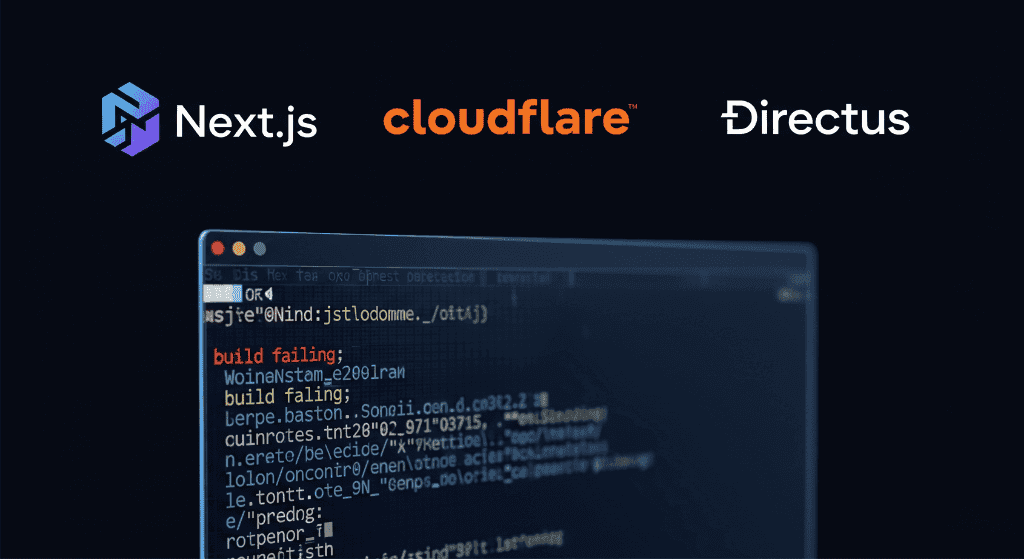
Next.js static generation randomly failing during npm run build with no server logs.
Problem: Silent Build Failures
$ npm run build

> reelabilities@1.0.0 build
> next build

- info Linting and checking validity of types
- info Creating an optimized production build
- info Compiled successfully
- info Collecting page data  .
  × Failed to collect page data for /toronto/films/[slug]
    Error: fetch failed
        at Object.fetch (node:internal/deps/undici/undici:11457:11)
        at async fetchFilmById (/app/.next/server/chunks/123.js:1:234)
Symptoms:
- Development: works fine
- Runtime: works fine
- Build time: random failures
- Server logs: empty
- CDN logs: empty
Diagnosis
# Directus container logs - nothing suspicious
docker logs directus-container -f --tail=100

# Caddy reverse proxy logs - clean
docker logs caddy-container -f --tail=100

# Cloudflare dashboard - security events empty
# Analytics dashboard - no unusual traffic patterns
Root cause: Cloudflare's bot protection silently blocking build-time API requests.
Evidence:
- Build-time requests are concurrent and automated
- CDN security treats this as suspicious traffic
- No logs because blocks happen at edge level
Solution: /etc/hosts Bypass
Bypass Cloudflare during builds while keeping it for runtime traffic.
# /etc/hosts
YOUR_SERVER_IP cmsdomain.com
Server configuration:
# Caddyfile - Handle direct HTTPS with IP restrictions
cmsdomain.com:443 {
    # Restrict access to build server IP only
    @allowed remote_ip YOUR_BUILD_SERVER_IP
    handle @allowed {
        reverse_proxy directus:8055
    }

    # Deny all other IPs
    handle {
        respond "Access Denied" 403
    }

    # TLS handled by Caddy with Let's Encrypt
    tls your-email@domain.com

    # CORS headers for API access
    header Access-Control-Allow-Origin *
    header Access-Control-Allow-Methods "GET, POST, PUT, PATCH, DELETE, OPTIONS"
    header Access-Control-Allow-Headers "Authorization, Content-Type, Accept"

    # Handle preflight requests
    @cors_preflight method OPTIONS
    respond @cors_preflight 204
}

# Still handle Cloudflare traffic on standard port (no IP restrictions for public access)
cmsdomain.com:80 {
    reverse_proxy directus:8055
}
Build environment:
# Build environment variables
NODE_ENV=production
CI=true
DIRECTUS_URL=https://cmsdomain.com

# Critical: Allow insecure SSL connections for direct server access
# This bypasses SSL certificate validation during builds
NODE_TLS_REJECT_UNAUTHORIZED=0
// Build-time API configuration
const DIRECTUS_URL = process.env.NODE_ENV === 'production' && process.env.CI
  ? 'https://cmsdomain.com'     // Direct to server during builds
  : process.env.DIRECTUS_URL;        // Regular runtime configuration

export const directus = createDirectus(DIRECTUS_URL)
  .with(authentication())
  .with(rest());
Results
$ npm run build

> reelabilities@1.0.0 build
> next build

✓ Linting and checking validity of types
✓ Creating an optimized production build
✓ Compiled successfully
✓ Collecting page data
✓ Generating static pages (247/247)
✓ Finalizing page optimization

Build completed successfully!
100% build success rate.
Production Setup
# CI/Build server /etc/hosts
YOUR_SERVER_IP cmsdomain.com

# Build environment variables
NODE_ENV=production
CI=true
DIRECTUS_URL=https://cmsdomain.com

# Critical for direct server access
NODE_TLS_REJECT_UNAUTHORIZED=0
Caddy config:
cmsdomain.com {
    # IP restriction for build server access
    @build_server remote_ip YOUR_BUILD_SERVER_IP

    handle @build_server {
        # Handle build server traffic (bypassing Cloudflare)
        reverse_proxy directus:8055 {
            # Optimize for build-time requests
            timeout 30s
            header_up Host {upstream_hostport}
            header_up X-Forwarded-Proto {scheme}
        }
    }

    handle {
        # Handle regular traffic through Cloudflare
        reverse_proxy directus:8055 {
            timeout 30s
        }
    }

    # Compression
    encode gzip

    # CORS
    header Access-Control-Allow-Origin *
    header Access-Control-Allow-Methods *
    header Access-Control-Allow-Headers *
}
Final Results
Over 3+ months: 100% build success, faster builds (no CDN latency), security maintained (IP restrictions), and runtime performance unchanged.
Debug Methodology
- Eliminate layers systematically
- Use /etc/hosts for CDN bypass testing
- Check build vs runtime contexts
- Monitor patterns, not just individual failures
- Test in isolated environments
Key Takeaways
- CDN bot protection can be invisible and inconsistent
- Build-time traffic patterns differ from user traffic
/etc/hostsis the fastest way to isolate CDN issuesNODE_TLS_REJECT_UNAUTHORIZED=0works for controlled environments- Dual-stack approaches let you optimize per context
Common Signs of CDN Interference
- Works in development, fails in CI
- Intermittent failures with no server logs
- Concurrent requests failing more than sequential
- Different behavior across CDN edge locations

Shyam Verma
Full Stack Developer & Founder
Shyam Verma is a seasoned full stack developer and the founder of Ready Bytes Software Labs. With over 13 years of experience in software development, he specializes in building scalable web applications using modern technologies like React, Next.js, Node.js, and cloud platforms. His passion for technology extends beyond coding—he's committed to sharing knowledge through blog posts, mentoring junior developers, and contributing to open-source projects.